Benjamin TenWolde

  • Principal Research Scientist · NAVWAR — Naval Information Warfare Center Pacific, San Diego
  • Founder & Director · NeuroML and NeuroVision Labs
  • PhD Candidate · Data Science, UC San Diego

My current research focuses on biologically inspired computer vision and perception. My work is in understanding the computational circuits that underlie robustness, adaptability and modeling.

I am a Principal Research Scientist at NAVWAR in San Diego, where I founded and direct the NeuroML and NeuroVision labs. I am completing my Ph.D. in Data Science at UC San Diego as a DoD SMART Scholar, advised by Dr. Virginia de Sa in Cognitive Science and Prof. Gary Cottrell in CSE. Previously I received my M.S. in Computer Science from Georgia Tech, where I was advised by Prof. David Joyner and Prof. Ashok Goel, and my B.S. in Electrical Engineering from the University of Rochester.

Benjamin TenWolde

Selected publications

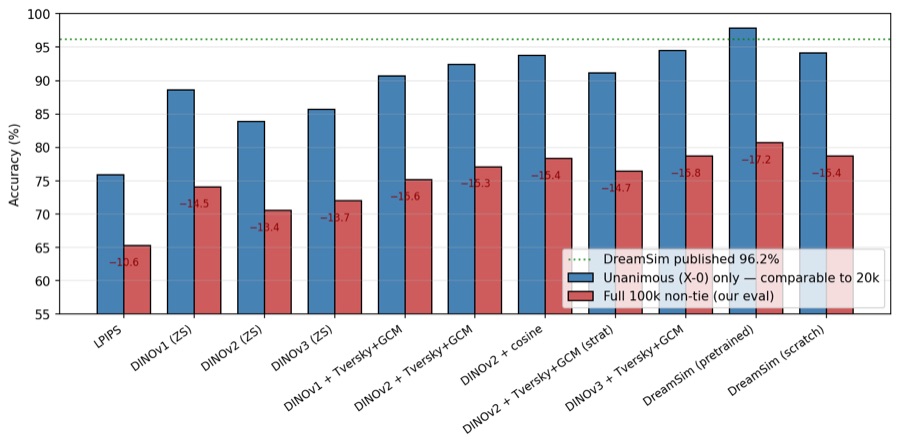
Accuracy of eleven perceptual-similarity metrics on the unanimous-agreement subset of NIGHTS versus the full non-tie corpus

Cosine is Human: The Reproducibility Ceiling of Perceptual Similarity

Benjamin TenWolde

NeurIPS 2026 · Evaluations and Datasets Track

On the 64,420 non-tie triplets, cosine distance on a frozen self-supervised backbone reaches 74.1% accuracy without training, LoRA fine-tuning reaches 77–79%, and the DreamSim ensemble reaches 80.7%. A split-half reproducibility estimate from the triplet vote counts shows that majority labels reproduce only 70.1% of the time overall.
EEG electrode montage and cortical classification during walking

A Convolutional Network Adaptation for Cortical Classification During Mobile Brain Imaging Preprint

B. Cichy, J. Lukos, M. Alam, J. C. Bradford, N. Wymbs

arXiv:2310.07941 · 2023

Our goal was to classify cognitive events from EEG signals while subjects simultaneously walked on a treadmill, sometimes while carrying a rucksack equivalent to 40% of their body weight. To our knowledge, these results are the first documented implementation of a DNN for the classification of cognitive neural state during dual-task walking.

U-Net autoencoder architecture for EEG ocular artifact removal

U-EEG: A Deep Learning Autoencoder for the Detection of Ocular Artifact in EEG Signal

J. Onners, M. Alam, B. Cichy, N. Wymbs, J. Lukos

IEEE Signal Processing in Medicine and Biology (SPMB) · 2021 · pp. 1–5

We evaluated an approach to address this limitation by modifying a U-Net convolutional neural network to extract blink artifacts from EEG signals contaminated with electrooculography signal. Our model removed ocular artifacts with a higher accuracy compared to the industry standard ICA algorithm.

Synthetic maritime vessel imagery rendered at varying spatial resolutions

Synthetic imagery for spatial resolution selection in maritime remote sensing

C. M. Ward, B. Cichy

Proc. SPIE 11733, Geospatial Informatics XI · 2021 · 1173305

We address a lack of class coherency across datasets at varying spatial resolutions by introducing a large 42-class synthetic dataset, Maritime Vessels at Varying Resolutions (MVVR-42). We explore the effect of spatial resolution on performance in ship detection tasks.

Talks & posters

  • 2026
    Humans Remember People; Models Remember Pixels
    Conference on Cognitive Computational Neuroscience (CCN), New York
  • 2019
    Cortical Classification During Mobile Brain Imaging
    9th International IEEE/EMBS Conference on Neural Engineering (NER)
  • 2019
    Cortical Classification During Mobile Brain Imaging
    Human Systems Conference, NDIA (HEF TAG)

Experience

  • 2021 — present
    Principal Research Scientist
    NAVWAR — Naval Information Warfare Center Pacific
    Founded and direct the NeuroML and NeuroVision laboratories, advancing biologically inspired machine vision and human-cognitive ML systems.
    • Grew a two-person group into a seven-PhD research program with significant DoD backing
    • Increased research grant funding by 500% through cross-institutional collaborations
    • Pioneered adversarial robustness methods for neural networks on defense platforms
    • Integrated GIS-based satellite mapping with image and spectral analysis for remote sensing and airborne detection
    • Consolidated lab IT, improving computation 5× and dataset storage 25×
  • 2020 — 2021
    Principal Scientist
    NAVWAR
    PI for machine learning classification of neuro-cortical (EEG) signals, and for NLP of scientific texts toward ontological understanding and knowledge graph development.
  • 2018 — 2020
    Scientist
    NAVWAR
    Managed multinational remote sensing algorithm development for low-resolution satellite imagery. Compressed a two-year program into five months while gaining 10% accuracy and a 1000% speedup.
  • 2015 — 2017
    3-Screen Studio
    Thermo Fisher Scientific · Millennium Health
    Back-end service development and reverse-engineering of LabVIEW-based instrument testing software for PCR machines, cutting field service engineer time 20×.
  • 2005 — 2011
    Earlier engineering
    NAVWAR · UC San Diego · LSI · Synopsys
    V-22 Osprey maintenance software; social-graph data collection at UCSD; staff engineer on 65 and 45nm clock methodology at LSI; back-end EDA applications engineering at Synopsys across 0.18µm, 90nm and 65nm tape-outs.

Teaching

  • UC San Diego
    DSC148 Introductory Machine Learning (Spring 2026) · DSC180A/B Data Science Capstone (Fall 2025 – Winter 2026, Fall 2026 – Winter 2027) · earlier TA appointments in VLSI design and digital integrated circuits (ECE 165, ECE 260A/B, CSE 143, CSE 241A)
  • Georgia Tech
    CS6601 Artificial Intelligence (Summer 2017) · CS7650 (Spring 2017)

Awards & service

  • DoD SMART Scholarship — 2023–present
  • Halıcıoğlu Fellowship — 2024–present
  • Program Chair, IEEE SPMB — 2022, 2026
  • Reviewer, NeurIPS — 2026
  • Reviewer, ICLR Workshop on Trustworthy AI — 2026
  • Reviewer, IEEE SPMB
  • IEEE Member — 2021–present
  • Society for Neuroscience — 2022–present